


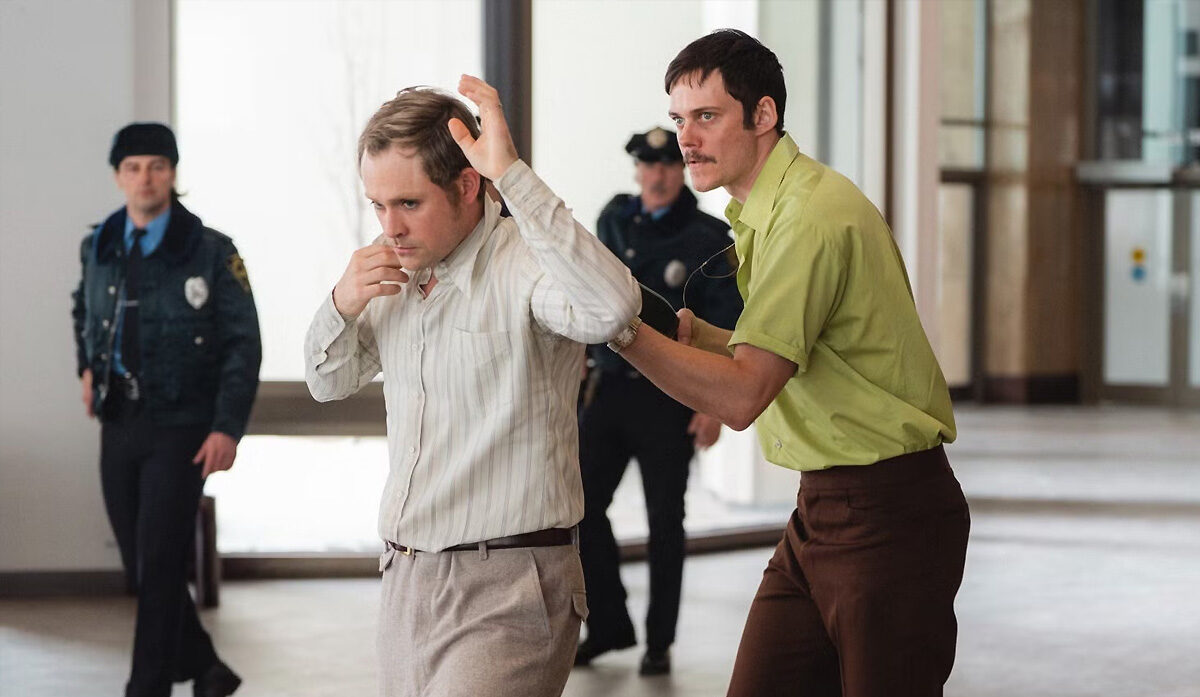
Dead Man’s Wire sees filmmaker Gus Van Sant at his most commercial as he dissects capitalism through the real-life folk tale of one man’s quest for justice. The film follows the real-life story of an Indianapolis man, Tony Kiritzis (Bill Skarsgård), who in 1977 kidnapped a banking company president after believing his mortgage broker deliberately sabotaged his property investment.
Feeling as authentically 1970s as the cars driven by the cops, Dead Man’s Wire is a slick thriller in the style of Sidney Lumet’s 70s Dog Day Afternoon. Scripted by Austin Kolodney, the film is tight, frill-free, and doesn’t waste time on unnecessary details. It’s a breath of fresh air in an industry concerned with exposition that Dead Man’s Wire jumps straight into proceedings.
The film begins in February 1977, with Tony walking into a corporate building carrying a mysterious box under his arm. He demands to see the loan company boss, ML Hall (Al Pacino). When he learns Hall is in Florida, he instead takes his son Richard Hall (Dacre Montgomery) hostage, jerry-rigging a shotgun to the man’s head with a wire. One wrong move and Richard is dead.
Over the next 63 hours, Tony holds Richard Hall hostage, demanding an apology and millions of dollars in compensation. Ambitious TV reporter Linda (Myha’la) spots the scoop as she watches Tomy march Richard through a busy city centre at gunpoint. He soon gathers the country’s attention, with Tony’s detective friend Michael Grable (Cary Elwes), his brother Jimmy Kiritsis (Daniel R. Hill), also watching his every move.
Initially, Tony isn’t doing it for attention; he is on a true mission: to let everyone know how corrupt the world of mortgage lending is. To get the word out, Tony calls into a local renegade radio station and decides to use popular DJ, Fred Temple (Colman Domingo), as his public mouthpiece. The public soon falls in love with Tony, and he becomes an outlaw folk hero to a post-Watergate America.
The kidnapper and the hostage shack up in Tony’s apartment, where the bulk of the action takes place. Tony’s confidence grows as each party works to insert their own narrative into his story. The audience will likely do the same thing, inserting their own personal viewpoint into the situation. Considering the current economic climate, many will sympathize with Tony’s stand on big corporations and their malpractice.
The opening half of Dead Man’s Wire is presented like a docudrama, intercutting the action with images and newsreels from both the film and the real-life incident. Especially effective are the reverse freeze-frames, which give the impression of photographs coming to life. Reality and fiction are blurred, much like the reporting that cares more about sensationalism than truth.

The story is surreal, and this script is fully aware of the absurdities of the real-life situation. The script is darkly funny, delivered with a sharp wit by Skarsgård. Anyone aware of the real-life Tony and his hostage-taking may argue that the film could have taken its zaniness even further. Stay to the mid-credit scene for a real clip of Tony’s television broadcast to witness just how eccentric the kidnapper was.
The writer and director work hard to never lose the humanity of Tony and his disillusionment in the death rattle of capitalism. When some scripts would focus on his declining mental health and bumbling actions, in Dead Man’s Wire, Tony is never less than a sympathetic folk hero who, understandably, is driven to the edge.
Thematically similar to Van Sant’s To Die For, this feels like a more palatable version of the director’s work. Fans of the director may feel slightly disappointed that the auteur has sanitized his voice for Dead Man’s Wire. Gone are the dreamy scenes and moody tracking shots. Instead, it is a more simplistic and sardonic version of the director’s trademarks. What is here, though, is Van Sant’s love of realistic, minimal dialogue.
Much of the film plays out of the apartment as Richard drifts in and out of consciousness, and Tony starts to believe his own hype. When the film becomes slightly bogged down with wordy conversations, the black humour keeps the momentum going. Fans looking for an action film may find themselves disappointed by Dead Man’s Wire, which plays out more like a character study than a crime thriller. It’s less about what Tony did and more about why he did it.
Bill Skarsgård is perfect as the Joker-esque Tony. Jittery and volatile, there is a sense that Tony doesn’t know what’s coming next, never mind the viewers. He balances being the bumbling everyman and the loose cannon, which could explode at any point. He falls out of cars, trips over his own feet, adding to the jeopardy that Tony might just do it. Few modern actors can do intensity like Skarsgård while also having the comedic timing to handle the sharp humour.
Although in a less showy role, Dacre Montgomery brings pathos as a man scared for his own life. The surrealist nature of the film needs an actor like Montgomery to keep the tone more grounded. Pacino gives a grounded, extended cameo as the sleazy banker at the end of a phone. Less a fully realized character and more a nod to Van Sant’s inspiration, Pacino avoids his larger-than-life trademark to remind audiences why he’s one of the greatest of all time.

Colman Domingo is one of the best casting choices of the year; his velvety tones are perfect for the role of a radio DJ. There is not enough of Domingo in this film, and Fred feels underutilized. Myha’la also doesn’t get the material she deserves, both immense talents being sidelined for too long.
Dead Man’s Wire suffers from not knowing how to handle the journalistic aspects of the story. Tony is obsessed with TV, films, and the radio, stuck in the echo chamber of the myth of America. He and the media start to build a symbiotic relationship; they use him for views/listen, and he uses them as his mouthpiece. The concept of clickbait and media infamy is not a modern one.
The film is so focused on Tony and his turmoil that it forgets the world around him. The supporting characters are blurry, missing an opportunity to add another layer to Tony’s story. Dead Man’s Wire could have benefited from fleshing out the media frenzy, especially Linda and Fred, who are more concepts of ideas than fully thought-out humans. The media and Tony became parasitic, both feeding off each other. This very timely concept isn’t explored enough.
While Dead Man’s Wire feels like it could have been made in 1977, the ideas speak very much to the modern world. It’s a scathing takedown of the American dream and the idea that anyone can get rich if they work hard. Tony learns the hard way that the rich get richer and the poor must continue to struggle, and nothing can affect that balance. It’s a story you’d expect to read coming out of 2025 America.
Grade: B-
Follow us on MSN for more content like this.
Dead Man’s Wire
Set in 1977 and based on a true story, Tony Kiritsis, a former real estate developer puts a dead man’s switch on himself and the mortgage banker who did him wrong, demanding $5 million and a personal apology.

