



Few projects have effectively leveraged the Mahershala Ali’s many talents (to say nothing of the limbo that Marvel’s Ali-led “Blade” reboot has been stuck in since 2019). But Benjamin Cleary’s Apple TV film “Swan Song” lets the actor deliver an incredible dual performance. For context, Cleary is best known for his Oscar-winning short “Stutterer,” a stunning exploration of isolation and how our relationship with communication informs our sense of self. In “Swan Song,” the theme of identity crops up again, but Cleary dissects it through the lens of a melancholic love story that doubles as a sci-fi drama.
When family man Cameron (Ali) is diagnosed with a terminal illness, he wants to spare his family any grief. This stems from an urge to protect his wife, Poppy (the wonderful Naomie Harris), from the pain of his inevitable absence. Thus, Cameron elects to take an unconventional route to achieve the impossible. Specifically, he decides to clone himself to help fill the void for his loved ones once he’s not around. In a conversation with the Los Angeles Times, Ali explained the challenges of playing two characters who look the same yet are very different:
“It was hard, in a certain way. Well, there was a part that was very easy because of Ben [Cleary] […] Those characters had, clearly for me, at least in the script and on the page, they clearly had different intentions. They clearly wanted different things. So, it truly was like playing two different characters […] I had to play it out in my head first and then try to explain how I think I want to play and still discover stuff in the moment. And then after that, Ben could be like, ‘That’s working, that’s not working,’ or whatever. And so that was the challenging thing.”
Swan Song uses a common sci-fi trope to tug at your heartstrings
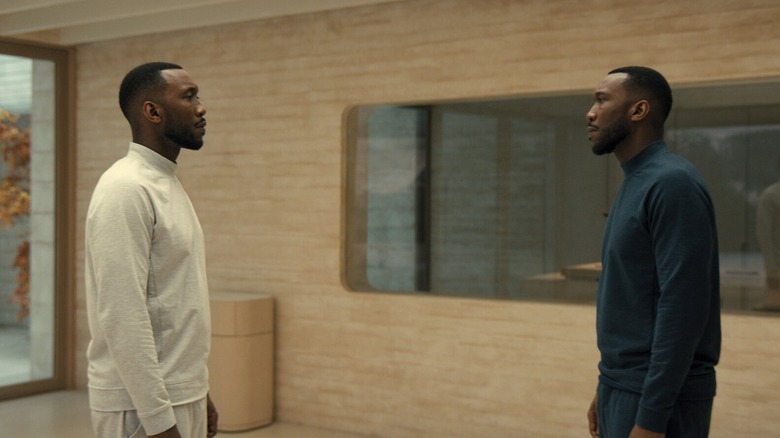
After Cameron decides to hide his diagnosis from Poppy, he visits Dr. Scott (Glenn Close), a scientist whose cloning facility seems ominous at first glance. It’s only natural; after all, cloning often functions as a cautionary trope in science fiction. Indeed, the concept of duplicating one’s self produces uneasy feelings — clones can only mimic sentience and can turn on the host body at any point. But Cameron isn’t too preoccupied with these misgivings, as his thoughts rest with Poppy and his children, who, he thinks, will get accustomed to the clone soon enough. At one point, Cameron meets a perfect clone of Kate (Awkwafina), another patient at the facility who seems to have found success with the procedure.
After the good doctor creates a medically healthy version of Cameron (named Jack), he spends time with the clone to fine-tune their personality. The plan is as follows: Cameron will stay back at the facility and die there, while Jack will have his memory wiped once he leaves the location, only retaining the “Cameron” memories that inform his identity. This echoes the Sam Bell situation from Duncan Jones’ “Moon,” where a clone spends most of his existence thinking that he’s the original (or, rather, the actual Sam Bell). But allowing a clone to take over one’s life is easier said than done, making Cameron realize that he’s not as prepared to go through with this as he thought he would be.
“Swan Song” is not preoccupied with the ethical implications of cloning. Instead, it’s a story about selfless (or selfish, depending on how you look at it) sacrifice, and the minutiae of Cameron’s inner landscape. This experience is as bittersweet as it gets.
“Swan Song” is streaming on Apple TV.

