


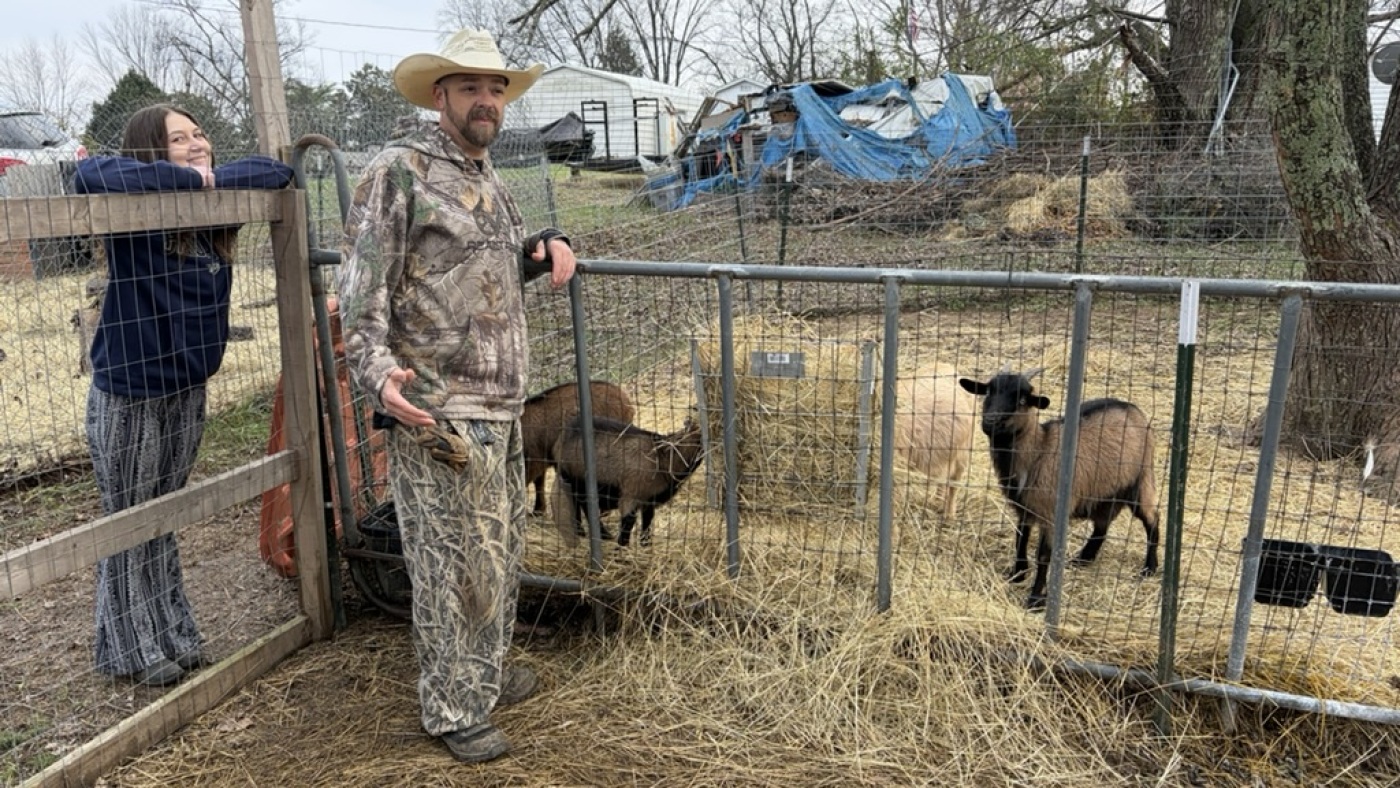
Robert and Emily Sory are starting an animal sanctuary at their home in Thompson Station, Tenn. In 2026, they plan to be uninsured. They’re looking for ways to pay for their care without coverage.
Blake Farmer
/WPLN News
hide caption
toggle caption
Blake Farmer
/WPLN News
It’s feeding time for the animals on this property outside Nashville. An albino raccoon named Cricket reaches through the wires of its cage to grab an animal cracker — an appetizer treat right before the evening meal.
“Cricket is blind,” said Robert Sory, who is trying to open a nonprofit animal sanctuary along with his wife Emily. “A lot of our animals come to us with issues.”
The menagerie in Thompson’s Station also includes Russian foxes, African porcupines, emus, bobcats and some well-fed goats.
The Sorys are passionate about their pets and seem to put the needs of the animals above their own.
Both Robert and Emily will start 2026 without health insurance.
Robert had been covered through a marketplace plan subsidized through the Affordable Care Act Marketplace. His share of the monthly premiums? Zero dollars.

Robert Sory feeds a blind racoon a treat before the evening meal.
Blake Farmer/WPLN
hide caption
toggle caption
Blake Farmer/WPLN
When he looked up the rates for 2026, he saw a barebones “Bronze” plan would cost him at least $70 a month. He’s decided to forgo coverage altogether.
“When you don’t have any income coming in, it doesn’t matter how cheap it is,” he said. “It’s not affordable.”
Dumping coverage
Marketplace plans from the Affordable Care Act no longer feel very affordable to many people, because Congress did not extend a package of enhanced subsidies that are expiring this month. An estimated 4.8 million are expected to go without coverage.
But even without a health plan, people will still need medical care. Many of them, like the Sorys, have been thinking through their “plan B” to maintain their health.
The Sorys both lost jobs in November, within days of each other. Robert worked as a farmhand. Emily worked at a staffing firm, and lost her insurance along with her position.
“It’s a horrible, horrible market right now. Really tough,” she said.
The first time she had to pay out of pocket for her three monthly prescriptions, it cost $184.
“To equate that to kind of how we think about it, you’re talking about 350 pounds of food for these animals,” Robert said. He pointed to his bobcats, who only eat meat.
Mapping out workarounds for the newly uninsured
To keep kibble in the food bowls, the Sorys are prepping for an uninsured future. They both see the same psychiatrist, and met with him. He said he was willing to work with them by charging $125 per visit. They’ll have to go every three months to keep their prescriptions current.
And if other medical problems emerge? They’re hoping for the best.
“I’m not somebody who gets sick super often, thank god,” Robert said. “And if I do, generally I go to an emergency room where they’re going to bill me later and I can get on a [re-payment] plan.”

Emily Sory feeding grey foxes at their home in Thompson’s Station, Tenn.
Blake Farmer/WPLN
hide caption
toggle caption
Blake Farmer/WPLN
Emily has some costly health conditions and has already taken on some substantial medical debt.
“It’s just sitting there, and I’ve racked up money,” she said. “But I’ve had to go to the doctor.”
Donated drugs and sliding scales
Hospitals and clinics are bracing for the influx of newly uninsured patients. They’re also concerned that people won’t know about alternative ways to get some medical care.
“We don’t have marketing dollars, so you’re not going to see big billboards or radio ads,” said Katina Beard, CEO of Matthew Walker Comprehensive Health Center in Nashville, Tenn. It’s one of the country’s 1,400 Federally Qualified Health Centers (FQHCs).
FQHCs are partially funded by the federal government. Although they don’t usually offer free care, their fees tend to be lower or on a sliding scale.
“It’s likely they will receive a bill,” Beard said. “But the bill will be based on their ability to pay.”
Many FQHCs also have their own on-site pharmacies, and some offer prescription medications for free through a partnership with the Dispensary of Hope, a Nashville-based nonprofit.
Many hospital pharmacies also partner with the nonprofit, which has distributed medication donated by pharmaceutical companies to 277 sites in 38 states.

Robert Sory preparing to feed meat to a bobcat.
Blake Farmer/WPLN
hide caption
toggle caption
Blake Farmer/WPLN
The participating pharmacies must make the medicine available free of charge to people without insurance who have annual incomes under 300% of the federal poverty limit.
The organization primarily sources medications for chronic conditions such as high blood pressure, diabetes, and mental health. Demand is expected to outstrip supply in the new year, according to CEO Scott Cornwell.
“We’re projecting and engaging with our manufacturers and asking them, ‘Are you willing to help support for this future status that we are anticipating?'” he said. “By and large,” he said, pharmaceutical companies have said they’re willing to step up.
“Their strategy, their position, what their outlook looks like is always an at-play issue. So it’s a continuous conversation that we’re having,” Cornwell said.
Ten states still have Medicaid ‘gap’
Hospitals will also have to find a way to care for more patients who can’t pay. Industry groups like the Federation of American Hospitals have been vocal about the threat to hospitals’ financial health, and have urged Congress to extend the enhanced subsidies, which come in the form of tax credits.
The impact might be most acute in states like Tennessee that have not expanded Medicaid to cover people who are working — but don’t get job-based insurance, and can’t afford it on their own.
Ten states have chosen not to expand Medicaid to uninsured, low-income adults — an optional provision of the ACA that is mostly paid for by federal funds.
This Medicaid “gap” is expected to cause uninsured rates to jump by as much as 65% in Mississippi, and by 50% in South Carolina, according to the Urban Institute.
As Emily Sory pets one of her Russian foxes, she admits she is keenly aware that she will soon become part of this unfortunate — and growing — population. After all, her last job involved healthcare staffing. Her mother is a nurse.
“I understand the system. And I get it’s people like me that don’t pay their bill are why it suffers. And I feel bad,” she said. “But at the same time, I don’t have the money to pay it.”
This story comes from NPR’s health reporting partnership with Nashville Public Radio and KFF Health News.

