



2025 was a strange year for many globally, and cinema reflected this. The backdrop of many of the year’s best films reflected the social and political climate, drawing inspiration from the current news cycle. This year also saw female voices make a big impact, both on and off screen. The film festivals were full of female-directed and written films about motherhood, grief, and trauma.
While cinemagoers complained about sequels, reboots and the unimaginative use of IP, there were plenty of original and unique films out there to enjoy (you might just have to hunt a little harder and outside of your cineplex).
Here are 15 films we loved in 2025.
Also, check our list of 10 Best Horror Films of 2025
Sinners
Ryan Coogler’s genre-defying Sinners felt like the rare thing in 2025 cinema: a truly original blockbuster. The film blended horror-movie tropes with historical drama and musical elements to create something unlike anything audiences have seen before.
Set in the 1930s, Michael B. Jordan stars as identical twin entrepreneurs who return from Chicago gangland to their Mississippi Delta hometown and open a juke joint. This new venue draws the attention of a group of white vampires (led by Jack O’Connell’s Remmick).
A visual feast for the eyes and the eyes, Sinners reminded everyone why cinema is important. And who can forget that extended scene where blues is introduced as the devil’s music before transforming through space and time into a kind of fourth-dimensional magical entity. Aside from its whipsmart exploration of mythology and race, Sinners is just a cool film.
The Secret Agent

Set in 1977, Kleber Mendonça Filho’s The Secret Agent is a human take on the political thriller. Set during Brazil’s long military dictatorship, Wagner Moura plays Armando, who returns to his northeastern hometown as a political refugee.
While the film is about the Brazilian political climate of the era, at its heart is the story of widowed Armando and the leftist safe house he is staying in. Inspired by the director’s own childhood and set in his hometown, the film is a haunting reflection of the era, interlaced with a human tale of a man seeking a better life with his son.
The Secret Agent is an immersive journey into Brazil under a dictatorship, with a colourful cast of characters and a blend of genres. With a rich narrative and complex characters, the film plays around with expectations and becomes something much more human than a standard political thriller.
Hamnet

Based on Maggie O’Farrell’s book about the death of William Shakespeare’s son, Hamnet, Chloe Zhao’s weepy is a cathartic tale of grief and how art can heal. Loosely based on the story of the bard’s real-life tragedy, the film follows William (Paul Mescal) and Agnes’ (Jessie Buckley) love story and their growing family until tragedy strikes.
With heart-wrenching performances from Buckley and Mescal, Hamnet is one of the most devastating movies in decades. Yet, despite the sombre subject matter, the film is strangely cathartic. It isn’t just about how young Hamnet’s death may have inspired Hamlet, it’s as much about parenthood and love as it is loss. Buckley’s grief-stricken screams will stick with you for many hours after the credits roll. I challenge you not to shed a tear during the cathartic finale.
Chloe Zhao’s directorial style is unapologetically raw, portraying Shakespeare’s little-known wife Agnes as an eccentric woman at one with nature. Zhao’s own witchines and respect for the world around her delightfully brings O’Farrell’s book to life. The film lyrically weaves in dialogue from the book and Shakespeare’s own prose to create a rich portrayal of the playwright and the woman who held his family together when he was putting on plays in Stratford-upon-Avon.
One Battle After Another

Loosely adapting Thomas Pynchon’s 1990 novel Vineland, Paul Thomas Anderson’s One Battle After Another is a postmodern epic about revolutionaries, right-wing politics, and our current treacherous socio-economic climate. The film follows a stealthy underground resistance over decades as they are hunted down by white politicians and military men.
The film never feels its 160-minute runtime, thanks to its blend of genres and grounded characters. It’s part political thriller, part slick action film and part a heartfelt story of a man trying to bond with his teenage daughter in a world that has evolved past him.
With a talented ensemble headlined by Leonardo DiCaprio and backed up by Sean Penn, Benicio Del Toro, Regina Hall, and Teyana Taylor, One Battle After Another is a darkly funny and provocative tale of American corruption. Anderson manages to deliver a timely story without becoming preachy, instead finding pitch-black humor in the cruelty of our society.
It Was Just An Accident

Iranian Jafar Panahi’s Palme d’Or-winning film was a powerful story about revenge and shared humanity. When a mechanic recognizes a man after his van breaks down as his torturer, he must make a moral dilemma.
It Was Just An Accident is an extraordinary story about revenge and retribution, as a group of people tortured at the hands of the Iranian regime must decide whether to recreate the pain he put them and their families through or rise above it.
The subject may sound dark, but it’s a surprisingly light and humorous story that still delivers a direct attack on the regime. As more and more people are shoved into the back of a van to plot revenge, the story veers toward farce, with each person representing a different part of the plan. But after the laughter comes the emotional wallop of the ending, making It Was Just An Accident one of the most remarkable revenge tales in cinema history.
If I Had Legs I’d Kick You

Mary Bronstein’s If I Had Legs I’d Kick You treats motherhood like an anxiety dream. Linda (Rose Byrne) battles a needy, ill child, an absent husband, and a hole in her roof. For this film, the most ordinary moments in Linda’s life are treated like cosmic or body horror.
If I Had Legs I’d Kick You is a raw and honest portrayal of motherhood, with Linda’s daughter and husband appearing predominantly as discombobulated voices out of frame. Byrne plays Linda with the anxious, paranoia turned up to 11. It’s often a difficult but very necessary watch, especially for women who may have sat on these feelings in silence.
In an era where women are supposed to have it all, this film realistically breaks down just how impossible that is. Even if a woman can maintain a job and a family, she will feel guilt at doing so. Byrne, with the camera closely panned on her face throughout, gives a career-best performance as a woman unravelling. For Linda, being a wife and mother is not a sacrifice to be celebrated, it’s a battlefield that has left her as broken as the roof of her home.
The Testament of Ann Lee

A musical about a subsect of the Quakers doesn’t sound like one of the best films of the year, but The Testament of Ann Lee is ambitious enough to sell the unusual subject matter. Mona Fastvold’s period epic tells the story of real-life Ann Lee (Amanda Seyfried), who starts the Shakers movement after personal tragedy. Is she unwell after the loss of her children or is she in conversation with higher powers? The people around her seem to believe she is a messenger of God.
The Testament of Ann Lee isn’t going to be for everyone, it makes a lot of big swings in terms of its blend of classic period drama and experimental musical. The ambition is held together by a remarkable performance by Seyfried, who shows off not just her vocal range, but her talent as a dramatic actress.
This is the type of film that gets under your skin and leaves an impression hours after you watch it. Even if you struggle to connect with the subject matter or the eccentric musical sequences, it’s hard not to be impressed by the sheer audacity of director Mona Fastvold’s filmmaking here.
Die My Love
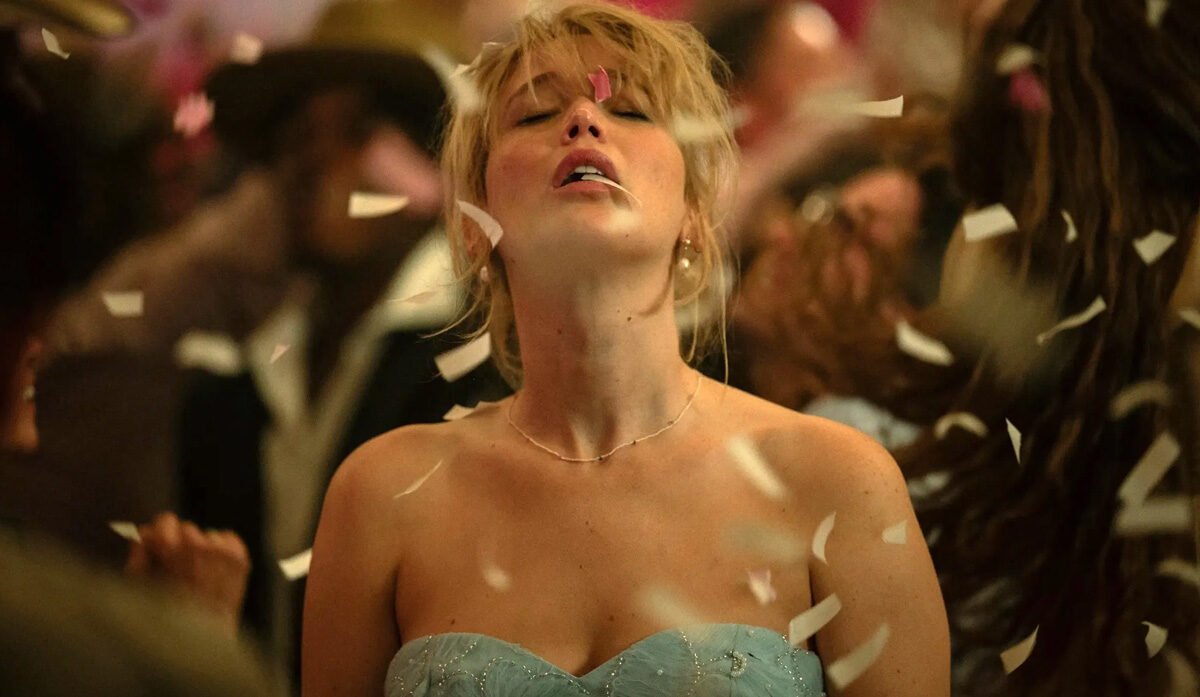
Lynne Ramsay’s Die My Love is an unflinchingly honest story about postpartum psychosis. Based on Ariana Harwicz’s 2012 novel, it follows a couple played by Robert Pattinson and Jennifer Lawrence as they move from New York to a remote farmhouse to raise their newborn son.
Lawrence gives one of the year’s rawest performances as a mother unravelling. She can’t express how she truly feels, especially when her smug husband is emotionally and physically distant. Instead of saying her emotions, Ramsay uses trance-like imagery to replicate the fraying mind of a sleep-deprived, lonely new mother.
Filmed in a cramped, 4:3 aspect ratio in an Americana-tinged fantasy, Die My Love is a film that stays with you. Complex, vulnerable, and not afraid to say the unspoken about womanhood, this is brave filmmaking at its best.
Sorry Baby

Debut writer/director Eva Victor’s Sorry Baby is the strongest breakthrough of the year and marks the arrival of a much-needed voice in filmmaking. The dark comedy/drama follows one woman’s trauma in the most human way possible.
Victor plays Agnes, a young academic, who must navigate her life after a s*xual assault. Instead of focusing on the violence and the anger of the aftermath, Sorry Baby portrays the fragmented way Agnes heals, and how it changes her relationship with the world around her.
It’s a quietly brilliantly written film about the resilience of survivors and avoids the uncomfortable tropes of sexual violence in modern cinema. It skips the voyeuristic graphicness and instead gently focuses on friendship and self-discovery. Funny, witty, and real, Sorry Baby gives sexual assault survivors their voice back.
Bugonia

Yorgos Lanthimos teamed up with Succession writer Will Tracy for a remake of Jang Joon Hwan’s Save the Green Planet! The dark fable was both out of this world and grounded in the death rattle of capitalism.
Jesse Plemons’ Teddy decides to kidnap the head of a pharmaceutical company (played by Emma Stone) because he believes she is a secret alien species determined to destroy Earth. The film satirizes conspiracy theory and incel culture without minimising the struggles of those who often seek alternative facts when real life stops making sense.
Bugonia is a razor-sharp takedown on modern life as Stone and Plemons’ conflicting ideologies battle it out against each other. The film forces the audience to question where their empathy should lie, and you won’t know who’s right and who’s wrong until the very last moments. No one can do kooky and mind bending like Yorgos, who continues his generational streak of good films.
Train Dreams

Based on Denis Johnson’s 2002 novella, Train Dreams is a poetic and dream-like chronicle of life at the start of the 20th century. Joel Edgerton plays a laborer who is forced away from his family to take on a job building bridges and logging in the Pacific Northwest.
With some of the most stunning cinematography of 2025, Train Dreams is a poignant meditation on the American dream. Joel Edgerton delivers a career-best performance as a solitary man facing a changing America. It’s a masterclass in quiet emotion as he relentlessly battles personal tragedy with a quiet resilience.
Train Dreams is a film unafraid to be poetically slow. It’s contemplative in a way that perfectly replicates memory. Even the most ordinary man’s life can be beautifully epic. The final scene may be the year’s most poignant.
Frankenstein

Guillermo del Toro’s reanimation of Mary Shelley’s 1818 classic was a lavish tale of family trauma and fatherhood. A movie decades in the making for the director, Del Toro’s passion project was a faithful adaptation of Shelley’s story with some added daddy issues.
Oscar Isaac took on the role of the egotistical scientist Frankenstein while Mia Goth played the object of his affections. The true standout was Jacob Elordi, giving the creature a tender pathos never seen in its many years of on-screen adaptations. It’s hard not to believe Elordi wasn’t actually a newborn creature slowly learning about the cruel world around him.
With immense attention to detail, Frankenstein was a feast for the eyes and ears thanks to cinematographer Dan Laustsen, a score by Alexandre Desplat, and lavish costumes by Kate Hawley. Violent, romantic, and immensely sad, del Toro found the humanity in one of history’s most famous gothic horrors.
Caught Stealing

Darren Aronofsky’s Caught Stealing is one of the year’s most underrated films. The crime thriller cemented Austin Butler’s star status, reintroduced Zoe Kravitz as one of the coolest women on the planet and reminded audiences how good Matt Smith can be.
Caught Stealing saw Butler’s bartender get caught up in the Lower East Side’s dangerous criminal underworld. As this slacker bartender becomes more and more embedded in the seedy side of New York, we meet more and more eccentric characters. It has corrupt cops, violent Orthodox gangs, sordid dive bars, and the everyman, everything a good crime thriller should have.
Set in 1990s New York, the film felt like a throwback to a different era of cinema, when filmmakers were a little slicker and scrappier. With clear inspiration from Martin Scorsese’s After Hours, this was funny, dark, fast-paced and a successful commercial for wearing your seatbelt. While Caught Stealing wasn’t the most revolutionary film of the year, it reminded us of the chaotic energy of 90s filmmaking.
Weapons

Zack Creggler’s crowd-pleasing Weapons terrified and made us laugh in 2025. His original script took huge swings, which mostly landed, as it borrowed from the expected sources (Stephen King) and the unexpected (Paul Thomas Anderson’s Magnolia). It’s full of unforgettable imagery, from the kids running away with their arms wide, the parents in a trance, and Aunt Gladys’ makeup-caked smile.
The film opens with a schoolteacher (Julia Garner) arriving at school one day to discover that all her students have mysteriously run out into the darkness in the middle of the night. She’s under fire from the town and the press, as the entire town of Maybrook blames her for their disappearance. It’s the modern witch hunt: trial by the media fuelled by small-town conspiracy.
Weapons is a brilliantly executed and original horror story with equally great scares and laughs. Split into different points of view, the film follows the different types of grief as a town tries to understand the mass tragedy. The cast is at their best here, from Josh Brolin’s angry father to Austin Abrams’ junkie, but Amy Madigan’s creepy Aunt Gladys stole the show as a defining horror icon of the 2020s. Creggler’s script can be enjoyed the what it is on the surface as a crowd-pleasing horror or for the layered allegories of grief, addiction and child abuse.
Follow us on MSN for more content like this.
More From Nerdspin – The 10 Best Actress Performances of 2025

10 Best Actress Performances of 2025
Nerdspin’s showcase of the ten most unforgettable best actress performances of 2025 brought to the screen.
Follow us on MSN for more content like this.
Also From Nerdspin – 10 Best Supporting Actress Performances of 2025

10 Best Supporting Actress Performances of 2025
Nerdspin celebrates the Best Supporting Actress Performances of 2025 with the year’s most powerful, surprising and awards-ready scene-stealers.
Follow us on MSN for more content like this.

